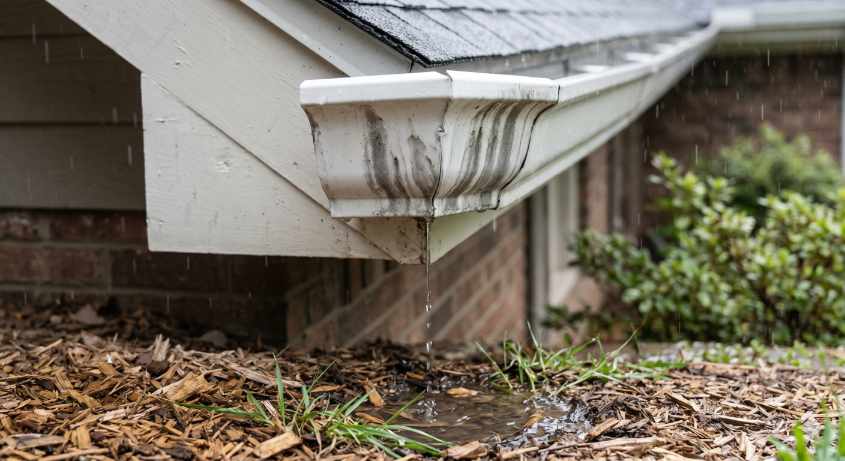
A leaking gutter corner is typically identified by dark gray streaks on the underside of the miter or visible water dripping from the joint during light rain. These leaks occur when the internal tri-polymer sealant becomes brittle and cracks due to South Dakota’s extreme temperature swings. Detecting a compromised corner in early spring prevents moisture from wicking into the wood fascia board, which leads to structural rot and expensive rafter repairs in homes across Sioux Falls and Beresford.
Key Takeaways for Gutter Joint Inspection
- The Tiger Stripe Signal: Look for vertical gray or black stains on the exterior of the corner joint.
- Secondary Drip Points: Check for “pitted” soil or dead grass directly beneath the gutter miters.
- Sealant Failure: Standard hardware store silicone is not rated for -20°F and will peel away from aluminum within one season.
- Fascia Protection: Once a corner leaks, water travels backward along the gutter bottom to the wood, causing hidden rot.
Why do gutter corners leak more than the rest of the system?
Even in a seamless gutter system, corners (known as miters) are the primary failure point because they require a manual joint. These joints are held together with fasteners and a specialized waterproof sealant. Because aluminum expands and contracts as temperatures change, the sealant is under constant physical stress. In South Dakota, where a 40-degree temperature swing in a single day is common, low-grade sealants lose their elasticity, pull away from the metal, and create a path for water to escape.
What are the visual signs of a leaking gutter miter?
You do not need a ladder to spot a failing corner. During a dry day, look at the very bottom of the corner joint for “tiger stripes”—dark, streaky mineral deposits left behind by leaking water. If it is raining, watch the corners specifically; if water is dripping from the seam while the rest of the gutter is bone dry, the internal seal has failed. Another major indicator is “back-splashing,” where water leaks from the back of the corner and runs down the siding, often leaving a green or brown algae stain on the house.
How does a small corner leak lead to fascia board rot?
Gutter corners are positioned at the most vulnerable parts of your roofline. When a seal breaks, water doesn’t just fall to the ground; it often “wicks” backward due to surface tension. This water crawls along the underside of the gutter and settles against the wood fascia board. Because this area is shaded and lacks airflow, the wood stays damp for weeks, leading to soft spots, fungal growth, and rot. By the time you see the wood crumbling, the structural integrity of your roof edge may already be compromised.
Why is high-grade tri-polymer sealant necessary for South Dakota?
In the Sioux Falls region, the “standard” caulking found in big-box stores is insufficient for gutter repair. Professional-grade tri-polymer sealants are engineered to remain flexible in temperatures ranging from -40°F to over 100°F. This flexibility allows the sealant to “stretch” with the aluminum as it expands in the summer sun and contracts in the winter cold. Using a high-grade sealant during a spring tune-up ensures the joint remains watertight for years, rather than just a few months.
Can a leaking corner be repaired without replacing the whole gutter?
Most leaking corners are easily repaired through a process of cleaning, drying, and re-sealing. A technician must first remove the old, failing sealant entirely—layering new caulk over old will not create a waterproof bond. Once the metal is scrubbed clean and dried, a new bead of industrial sealant is applied to the interior of the miter. This simple maintenance step restores the system’s integrity and is significantly more cost-effective than replacing entire lengths of seamless aluminum.
Professional Standards for Leak Repair
- Preparation Protocol: All A+ Gutters repairs include a mechanical cleaning of the joint to ensure 100% adhesion of the new sealant.
- Material Specification: We exclusively use industrial-strength sealants that are UV-resistant and specifically formulated for K-style aluminum gutters.
- Local Expertise: Our repair teams are familiar with the specific “wind-loading” challenges in the Beresford and Vermillion areas that can put extra physical strain on corner joints.
Stop the drip before it rots your home. Contact A+ Gutters for a Professional Leak Inspection to identify and fix failing corners before they cause structural damage. You can also call or text us at (605) 351-5900 to speak with a local specialist.